
A simple three-step approach to saving and spending
Consider this budgeting approach to manage spending and saving
Key takeaways
- The budgeting approach below is a starting point for organising your finances. It is not a one-size-fits-all rule.
- Consider saving at least 10% of your gross, pre-tax income, including any employer contributions (if applicable), for retirement (noting the amount you need to save may vary depending on factors such as your location and individual circumstances).
- Consider keeping essential expenses to 60% or less of your take-home pay.
- Consider allocating no more than 50% of your net (i.e. after-tax) income to essential expenses.
- Consider allocating up to 30% of your take-home pay to “nice-to-have” expenses such as restaurants, hobbies, and entertainment.
- Consider putting 10% or more of your take-home towards near-term goals and emergency savings.
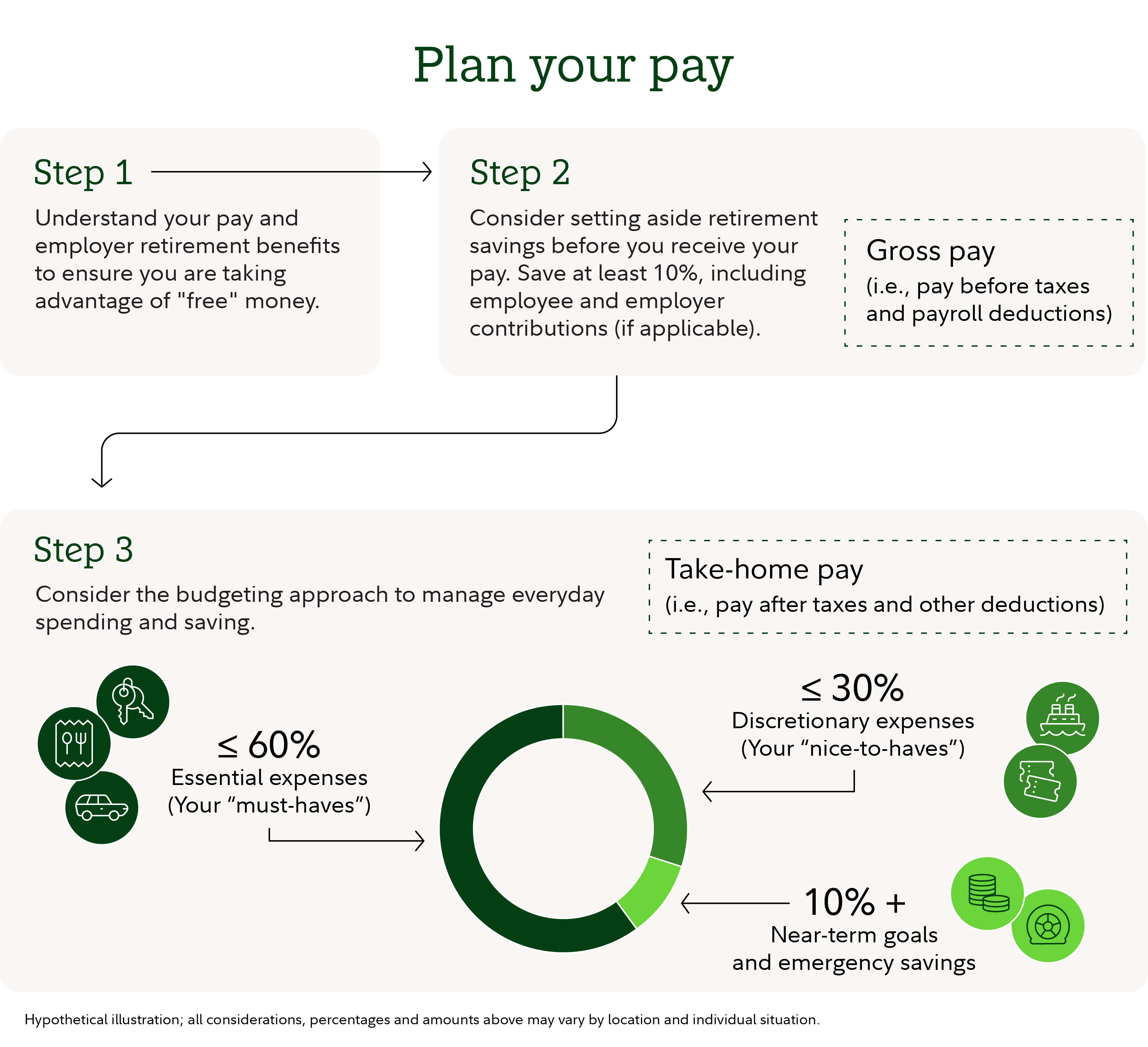
Managing your money does not have to be complicated. The following approach offers a simple starting point for consideration:
- At least 10% of your gross, pre-tax income, including any employer contributions (if applicable), for retirement (noting the amount you need to save may vary depending on factors such as your location and individual circumstances).
- 60% or less of your take-home pay for essential expenses
- 30% or less of your take-home pay for nice-to-have discretionary spending
- 10% or more of your take-home pay for near-term goals and emergency savings
Because everyone’s situation is different, these numbers are suggested goals for you to consider as a starting point, not strict rules. If you are not there yet, that is okay, you can work toward this gradually to help strengthen your financial foundation. Even small, consistent steps can make a significant difference over time.
At least 10%: Pay yourself first and save for retirement before you get your paycheque
It is important to save for your future, no matter how young or old you are. Why? More countries and employers are looking into moving away from retirement plans that guarantee a benefit amount upon retirement. Social Security programs and other government retirement plans are increasingly struggling to guarantee the future solvency of their programs and meet the needs of aging populations. In many cases, the retirement programs people have relied on in the past may not provide all the money a person needs to live the life they want in retirement.
In fact, we have estimated that individuals in some countries may need to rely on additional savings to supplement their social security benefits, aiming to replace between a third and a half of their pre-retirement income. Based on these savings goals, most individuals will likely need to save additional amounts through a combination of employer-sponsored and private pension arrangements.
How do you know your retirement savings goal?
Do some research with your current retirement plan provider or your country’s retirement program authorities. Some general estimates may be publicly available, or your retirement plan provider may be able to provide some information. Some of the main goals would be to estimate what portion of your pre-retirement income is expected to be replaced by your existing legally-required plans, and what your annual savings rate could need to be to supplement that benefit.
Consider saving at least 10% of your pre-tax income for retirement. This includes your contributions plus any matching or profit-sharing contributions from an employer (if applicable). Please note that the amount you need to save may vary depending on factors such as your location and individual circumstances. Starting early, saving consistently, and investing wisely can be crucial to hitting your retirement goal.
One of the easiest ways to save before you get your paycheque is by contributing to an employer's workplace savings plan, if available to you. Many employers match contributions up to a certain percentage of income, which is like “free” money, so saving at least up to the match (if offered) can make good sense if you can afford to. In some countries, you may also be able to allocate a portion of your annual raise or incentive pay (bonus, commissions, etc.) in a tax-effective way into an individual retirement account up to a pre-defined threshold.
But what if you do not have a retirement plan through your employer?
You can still automate your savings. Consider setting up direct deposit to a personal retirement account or scheduling automatic transfers from your current accounts on the day you get paid.
What if saving at least 10% is too much to handle right now?
Do not worry, simply start by saving what you can. Try to save at least enough to get any match offered by your employer (if applicable) and then aim to increase the amount you are saving just a little bit with every raise and promotion. It really can add up in the long term.
60% or less: Must-have expenses
Some expenses are simply not optional; you need to eat, and you need a place to live. Consider allocating no more than 60% of your take-home pay to “must-have” expenses, such as:
- Housing: mortgage, rent, property tax, utilities (electricity, internet, etc.), homeowner’s/renter’s insurance, and flat/home association fees.
- Food: groceries only; do not include takeout or restaurant meals, unless you really consider them essential, i.e., you never cook and always eat out, or you eat out daily when at work.
- Health care: health insurance premiums (unless they are made via payroll deduction) and out-of-pocket expenses (e.g., prescriptions, copayments).
- Transportation: commuter fares, taxis/ridesharing, costs of owning a car/bike (loan/lease, petrol, car insurance, parking, tolls, maintenance).
- Childcare: day care, nursery school or pre-school, kindergarten, school-age childcare, tuition, and fees.
- Debt payments and other obligations: credit card payments (including online/mobile loans), student loan payments, child support, alimony, and life/disability insurance. If you use your credit card to pay for daily expenses that are already categorised in your budget, be sure to only count those once.
What if your essential expenses are more than 60% of your take-home pay?
Everyone’s financial life is unique, and some life stages are more expensive than others. If your essential expenses regularly run over 60%, it may help to try to trim them so you can save more and have more money for discretionary spending. Even essential costs often have flexibility. Small changes can add up, such as using energy-efficient lights and appliances, looking for bargains at the grocery store, and bringing your lunch to work. You may also drive a more affordable car/bike, sharing rides (carpooling or car sharing), or taking public transport. Focus on which essential expenses are most important, and which ones you may be able to cut back on, especially if you tend to need to borrow to cover your expenses. These adjustments can free up some money and may give you more breathing room.
It can also be a good idea to familiarise yourself with your employer’s benefits, if you have them. There can often be benefits that offer “free” money and discounted premiums, so make sure you are taking full advantage of everything your employer offers.
30% or less: Nice-to-have expenses
While not essential to your survival, these types of expenses make life a little better. Consider allocating up to 30% of your monthly take-home pay to what you choose to spend on, such as restaurants, entertainment, hobbies, travel, subscriptions, and charitable donations.
10% or more: Near-term goals and emergency savings
Setting aside at least 10% of your monthly take-home pay can help you save for both significant events and smaller, unplanned expenses. Being financially prepared can help you feel more confident and less likely to pay for things by adding to an existing credit card balance.
For instance, if you are saving for a holiday or a new car, money in this category could help boost your efforts. You could also consider setting aside this money to cover “one-off” expenses like a new smartphone, car repairs, and maintenance, buying holiday gifts, and so on. It is generally good practice to set aside some money for unexpected expenses so you will not be tempted to tap into your emergency savings or pay for them by adding to an existing credit card balance.
If you do not have any savings, prioritise some of the 10% towards building up your emergency savings. It is intended to cover unexpected expenses which may result from a job loss, prolonged illness, household repairs, or medical expenses. Consider having enough put aside in savings to cover 3 to 6 months of essential expenses. Think of emergency fund contributions as a regular bill every month, until there is enough built up (instead of an uncertain amount when the need arises).
What about other goals like saving for a child’s education?
If you are planning for future education costs, for example, a child's university education, those savings would typically come from the 10% category for near-term goals. This bucket is designed for things you want to fund over the next few years, and education savings fits that description.
On the other hand, if you are currently paying education expenses, such as tuition or fees, they are more of an essential cost and would usually fall under the 60% category of must-have expenses. These are obligations you need to cover now, like housing or childcare.
Why this approach?
Separating retirement savings from your everyday budget helps you see two things clearly: what you are setting aside for the future and what is available for today. The following budgeting approach breaks this into simple parts, covering daily spending, short-term goals, and long-term savings such as retirement.
The underlying research and maths supporting this approach propose that it may help you achieve financial stability today and maintain your current lifestyle in retirement.
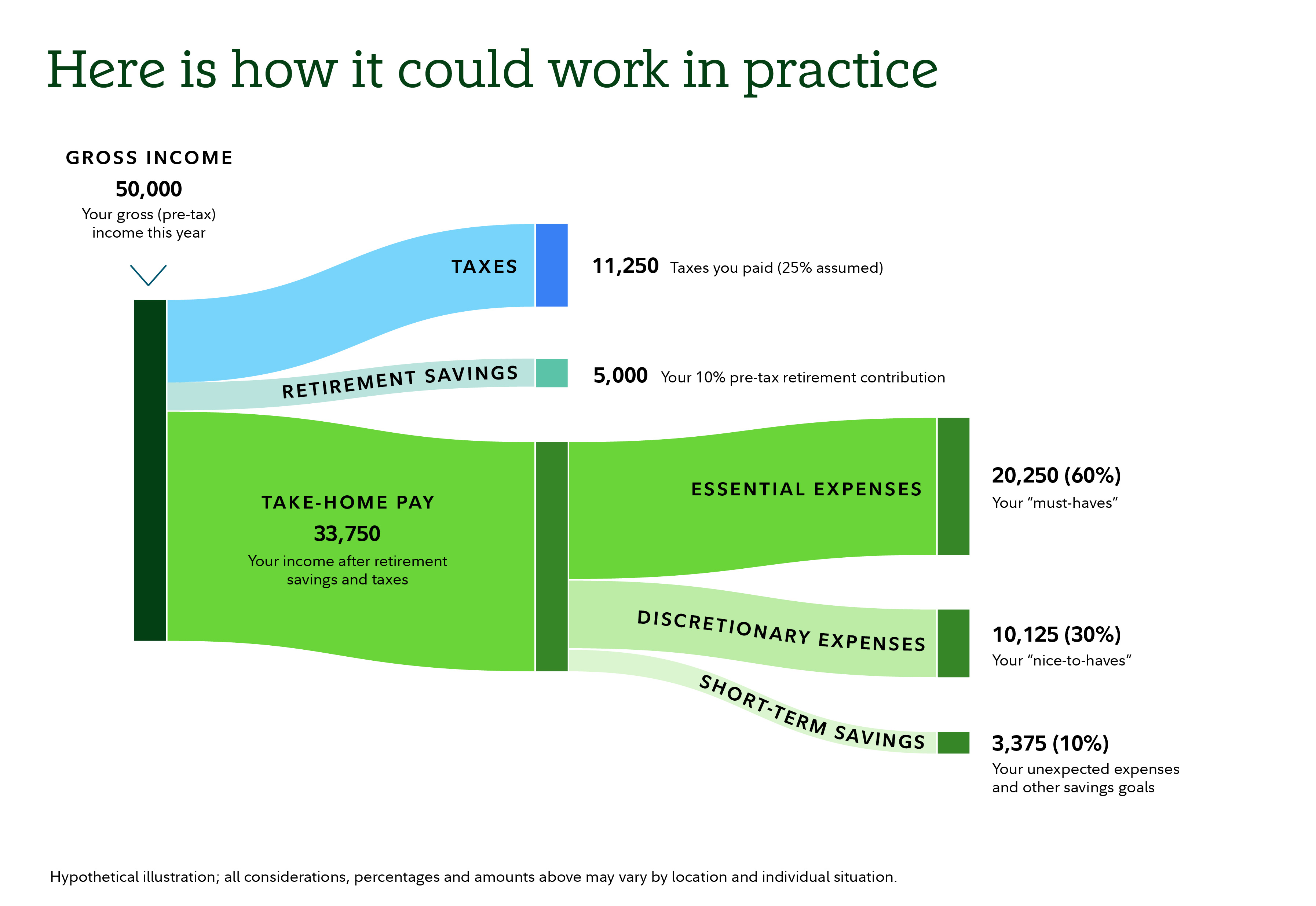
A simple budgeting approach
Gross annual income |
| 50,000 |
|---|---|---|
Retirement savings contribution (employee contribution) | 10% | 5,000 |
Taxes (as applicable in your location) | 25% assumed | 11,250 |
Essential expenses (“must-haves”) | 60% | 20,250 |
Discretionary expenses (“nice-to-haves”) | 30% | 10,125 |
Savings (near-term goals and emergency savings) | 10% | 3,375 |
For hypothetical illustration; all considerations, percentages and amounts above may vary by location and individual situation.
What is next?
This approach is intended to serve as a flexible starting point, not a substitute for a comprehensive financial plan. It is important to evaluate your situation and the options available locally or through your employer (if applicable) to adjust these figures as necessary. If you feel that you have a good grasp on the amount of money coming in and going out each month, you may be ready to start optimising your finances and growing your wealth.
Consider the following ideas:
- First, pay down high-interest debt.
- Establish other goals, like paying for a house improvement or a wedding; you could use the remaining income to save for them.
- Finally, for those who want to retire early or have not been saving consistently, putting extra money toward retirement savings may make sense.
The good news is that it is not about tracking every coin; it is about feeling in control and confident of where your money goes. Using the categories discussed in this article can help you understand your spending and the flexibility you have in your finances. Almost everyone’s financial situation will change over time. Life changes, such as a new job, marriage, or kids, may change your cash flow, so be sure to revisit your budget regularly, especially after significant life events.

1251194.1.0